G98 and G99 are decided by one number: 16A per phase, measured across everything installed at the property, not per device. The comparison table, the G99 Fast Track route that sits between the two, and the design-capacity rule most guides get wrong.
Payaca is the operations platform for clean tech installation businesses.Book a demo →
Jamie Duncan
Head of Customer Operations·31 August 2026·Last updated: 7 September 2026
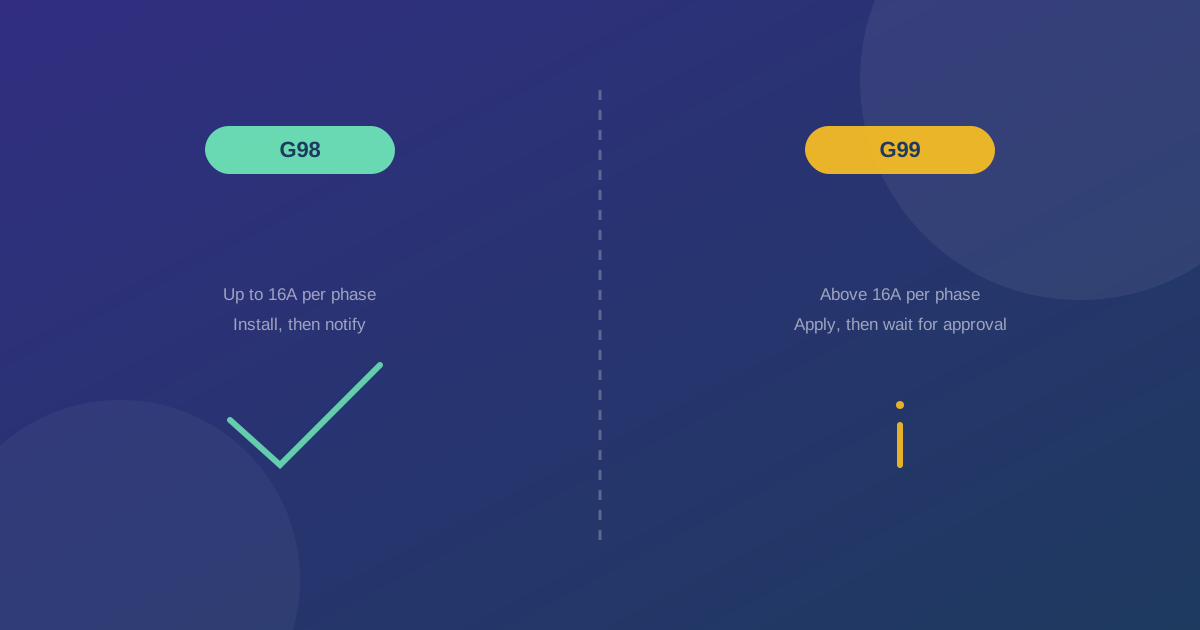
G98 and G99 are the two Energy Networks Association routes for connecting generation and storage equipment to the electricity grid. Which one applies comes down to a single number: 16A per phase, measured across everything installed at the property, not per device. Under that, you install and notify the DNO afterwards. Over it, you need approval before you start. Our DNO application checker works out which route a specific job needs from the postcode, the technology and what is already installed there.
Key points
The threshold is 16A per phase - 3.68kW on a single-phase supply, 11.04kW on three-phase - and it covers everything installed at the premises, not one device
Adding a second system to a property that already has generation can push the combined total over the line, even when the new device looks small on its own
G98 is connect, commission, then notify within 28 days. G99 is apply and wait for approval before you install
A system that will not normally run in parallel with the grid for more than five minutes a month, or is designed to island, goes through G99 regardless of size
Going over 16A does not automatically mean a full G99 study. The G99 Fast Track route covers installations up to 60A per phase and turns round in about 10 working days
The threshold is measured on Registered Capacity, not the size of the inverter, so a 7.36kW inverter with a factory-set 3.68kW export limit stays on the notification-only route
Multi-technology jobs - solar plus battery plus EV charger prep - are where installers most often get the route wrong
16A per phase or less (3.68kW single-phase, 11.04kW three-phase)
Above 16A per phase, no upper limit
Order of work
Connect, commission, then notify
Apply, wait for approval, then install
DNO approval before install
No
Yes
Application fee
None
£500 to £2,500 typical for a full assessment, varying by DNO and complexity. Check the Fast Track fee with your DNO, it is charged differently
Timescale
Notify within 28 days of commissioning
About 10 working days on Fast Track. 45 working days for the DNO to issue a connection offer on a full application
On the job's critical path
No
Yes
Typical job
Domestic solar, small battery
Solar plus AC-coupled battery, commercial rooftop, V2G, anything at scale
The row that matters most is the last-but-two. A G98 does not hold the job up, and a G99 does, which is why the aggregate calculation is worth getting right before you quote a start date rather than after.
Working out G98 or G99 automatically
Payaca determines the application type from what you select on the job - heat pump, EV charger, battery, V2G, solar panel - and tracks it through to commissioning. See how it works.
Both standards come from the same source: EREC G98 and EREC G99, published by the Energy Networks Association. A micro-generator is defined as equipment "designed to operate in parallel with a public Low Voltage Distribution Network with nominal currents up to and including 16A per phase," and the standard applies that limit to the aggregate capacity installed at the premises, not to each device separately.
On a standard single-phase domestic supply, 16A works out to 3.68kW. On three-phase, it is 11.04kW. Anything at or under that goes through G98. Anything over it needs a full G99 application, with a technical assessment and formal approval before you connect. What triggers a G99 rejection, and how the assessment timescales vary by network covers what happens once a job is over that line.
The line most guides skip is that the 16A figure applies per premises, not per box, and the ENA definition names storage devices specifically. A 4.2kWp solar array with a 3.68kW inverter sits right at the G98 boundary on its own. Add a 3kW battery inverter for storage later, and the property's combined capacity moves to 6.68kW - comfortably into G99, even though neither piece of kit looks large by itself.
This catches retrofit jobs more than new-build ones, because the first installer often has no visibility of what is already on site. If the property already has solar registered under G98, a second contractor adding a battery needs to know the existing capacity before they can tell which route the new work needs. Export limitation and the G100 route covers the one way to keep a combined system under the threshold without dropping capacity.
For a single premises under the threshold, G98 does not involve the DNO before you connect. Your installer commissions the system, then submits the G98 installation document within 28 days. It is a legal requirement, not a courtesy, but it does not sit on the critical path of the job.
G99 reverses the order. The application goes in, the DNO assesses it against network capacity, and only once you have approval - or approval with conditions - can you install. That puts G99 squarely on the job's critical path, which is why getting the application right first time matters more than it would for a G98 notification.
There is a third route worth knowing if you run installation programmes rather than one-off jobs: G98 also has a multiple-premises path for connecting several systems in the same close geographic region within 28 days, which does involve notifying the DNO before you install rather than after. It is a different process from single-premises G98, and easy to miss if you are used to the connect-and-notify version. When the DNO replies and nobody notices is about the same category of process gap - status changes that need a response and do not always get one.
Most guides present this as a binary, and it is not. Cross the 16A line and the assumption is that you are now into a full G99 assessment with a fee and a three month wait. For a lot of domestic and small commercial jobs that is wrong, because EREC G99 also carries a Fast Track process for Small Generation Installations, and the DNOs run it as a separate queue.
There are three SGI categories. All of them require that the equipment sits in a single generator's installation and that every generating unit, storage included, runs through a G98 or G99 type tested inverter. Kit installed before 27 April 2019 can be G59 or G83 type tested instead.
Design capacity, per unit
Registered capacity, per unit
Total registered capacity
G100 export limit
Form
SGI-1
32A (7.36kW) or less
16A (3.68kW) or less
16A (3.68kW) or less
Not required, the inverter's limit is factory set
A3-3, notification only
SGI-2
32A (7.36kW) or less
16A (3.68kW) or less
32A (7.36kW) or less
May be required, capped at 16A (3.68kW)
A1-2
SGI-3
32A (7.36kW) or less
32A (7.36kW) or less
60A per phase or less
May be required, capped at 32A (7.36kW)
A1-2
SSEN aim to respond within 10 working days. Once the assessment clears you have three months to install and commission, and Form A3-2 goes back to the DNO within 28 days of commissioning, the same as a G98.
Work in amps rather than kilowatts on the 60A line. The standard is written in amps per phase, and the published kilowatt conversions do not agree with each other: SSEN quote 14.72kW where a straight 230V conversion gives 13.8kW. The amp figure is the one the DNO assesses against.
The distinction the SGI table turns on is the one worth carrying back to every job. Intrinsic Design Capacity is what the unit is built to produce. Registered Capacity is what it is actually permitted to export, set by the manufacturer at the factory or by an installer-configured G100 export limitation scheme.
The thresholds are assessed on registered capacity. That means a 7.36kW inverter whose export is factory limited to 3.68kW is an SGI-1 notification, not a full application, even though the datasheet headline number is double the G98 threshold. Reading the top line off the datasheet and concluding that the job needs a full G99 is one of the more expensive mistakes available here, because it adds months to a quote that did not need them.
It cuts the other way on aggregation. Two units that each sit inside SGI-1 on their own can put the premises total over 16A and move the job to SGI-2, which is an application rather than a notification even though nothing about either piece of kit changed.
EREC G99 also covers equipment that would otherwise qualify for G98 on capacity alone, if it does not normally run in parallel with the public network. Anything designed to connect for less than five minutes a month, or to operate islanded rather than exporting to the grid, falls outside the micro-generator definition and needs a G99 application regardless of size. It is a narrow case in practice, but it is the kind of detail that gets an otherwise straightforward domestic job bounced if nobody checks for it.
Solar panels, batteries with grid-tied inverters and V2G chargers all count toward the same premises total, because they can generate or export in parallel with the network. Heat pumps and standard EV chargers sit on the demand side, so they matter for the load calculations but not for the 16A generation aggregate. A job that adds solar, a battery and prepares wiring for an EV charger can cross the 16A threshold even when each piece read as G98-eligible on its own datasheet. Solar PV commissioning under MCS and heat pump commissioning under BUS V5 cover the certification side of the same multi-technology jobs.
This is where a spreadsheet approach breaks down fastest, because the person filling in the DNO form for the battery add-on is rarely the person who filed the original solar notification. Payaca's DNO application card lives on the project itself, so the devices on a job and their capacities are recorded on that project's DNO application, not buried in a previous engineer's paperwork. See grid connections for how the application, the type search and the commissioning submission sit together.
Getting the route wrong costs time either way. File G98 when the job needed G99, and you have installed ahead of an approval you were required to get - a compliance problem, not just a paperwork one. File G99 when G98 would have done, and you have added weeks to a job that did not need them. Automating commissioning submissions and DNO works required: what the status means cover what happens on the other side of a correctly filed application, once the DNO responds.
When a full-export G99 connection would be refused or need reinforcement, an export limitation scheme (ENA EREC G100) keeps the job alive. Here is how it works and how to track it across a busy install schedule.
A G99 application covers any system above the G98 threshold and has to be approved before you install. What triggers one, how long approval takes on each network, and the errors that send it back.
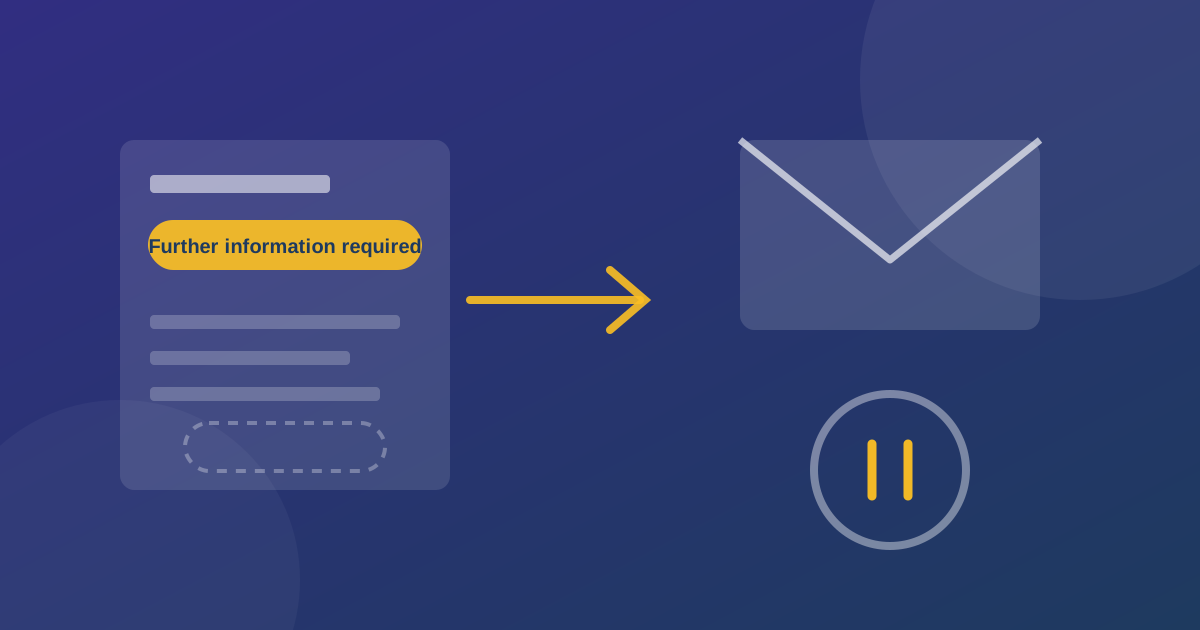
'Further information required' is not a rejection. What the status means, where the DNO actually contacts you, and what it does to the 45-working-day clock.