
Blog
Jobber alternatives for solar and clean tech installers
Jobber works well for general trades. Here's an honest look at the alternatives when solar, heat pump, or EV charger work pushes you past what it can handle.
This article compares different types of solar technology that are available to choose from.

Felix Rusby
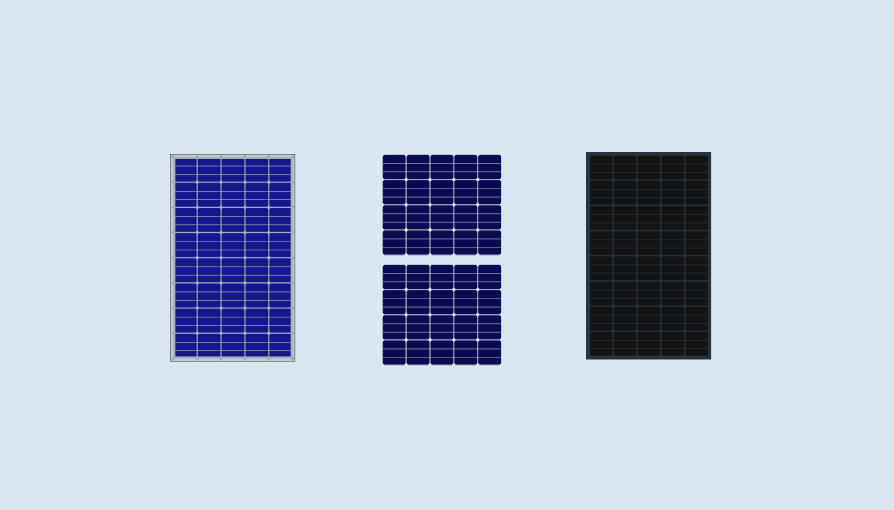
Solar panels come in all sorts of shapes and sizes. Some are used to produce grid-level energy production, some are installed on domestic rooves and some exist to stop your calculator from running out of battery.
There are essentially two primary types of solar panel: monocrystalline and polycrystalline.
Both types are made via essentially the same process, except that the mono silicon used in monocrystalline panels requires an additional stage of processing, creating a higher purity finished product.
Whereas polycrystalline is created from lots of small crystals, monocrystalline uses one large crystal. This means monocrystalline panels are more efficient.
Due to technological improvements and the general decrease in the cost of solar panels, monocrystalline panels have now become the dominant form of solar technology with polycrystalline effectively becoming obsolete.
Half cut panels take the standard monocrystalline design and cut the panel into two parts. This technique allows two separate paths for electrons to flow, reducing the impact of shading or damage. Half-cut panels can maintain up to 50% more efficiency when experiencing partial shading compared to standard panels.
Most half-cut panels also make use of PERC cell technology helping to further increase efficiency.
PERC cells use an additional layer that reflects unused light back into the cell. These panels produce 6-12% higher output efficiency compared to traditional mono cells. They also cope better in lower light or shaded conditions.
This cell design combines crystalline silicon cells with a thin film layer of amorphous silicon.
Benefits include:
A brand example would be the REC Alpha Pure panels.
N-type solar panels are similar to PERC cells, but where P-type uses boron, N-type uses phosphorus. This makes them:
To find this technology, look at the Q Cells Q.Tron solar panels. Great for ground-mounted installations where they can use reflected light on both sides.
When talking about solar efficiency this refers to the amount of electricity produced in proportion to the volume of sunlight that directly hits the solar panel. Even the most efficient panels lose some energy through heat, reflection, or sunlight passing through.
Solar panels don't operate at 100% efficiency forever. A standard degradation rate is around 0.5% per year. Premium solar panels tend to degrade at around 0.25% per year - meaning over its lifetime, a premium panel will maintain its efficiency far longer.
Most solar panels operate best at around 25°C (77°F) and will lose a small percentage of their performance if this is exceeded. Important if you're in regions with high temperatures.
At the top end of the market, you can find 30-year performance guarantees. However, be careful - several solar manufacturers have experienced financial issues recently. A warranty is only as good as the company that offers it.
Solar technology is developing quickly with new designs and innovations making it difficult to keep up with what's available on the market.
When choosing what type of solar panel is best for you, talk to your installer and work out the exact requirements for your property. Are you looking for rooftop or ground-mounted? What is the shading like? Is your roof south-facing?
Having an idea of what is available on the market and what questions you need to ask will allow you to ensure you find the best fit for you.
See how Payaca helps clean tech installers save time and grow their business.
Book a demoJobber works well for general trades. Here's an honest look at the alternatives when solar, heat pump, or EV charger work pushes you past what it can handle.

G98 and G99 are decided by one number: 16A per phase, measured across everything installed at the property, not per device. The comparison table, the G99 Fast Track route that sits between the two, and the design-capacity rule most guides get wrong.

Most install businesses cost jobs from the quote, not from what was spent. Where the gap opens up, and what accurate job costing needs in practice.