Sunbase is configurable contractor software for solar, roofing, construction and home services, bought per user and module by module, with PV design, shading and production in the platform. Enerflo is residential solar sales software: it's built around the proposal, with battery sizing, savings forecasts and loan, lease and PPA financing built in, and its pitch is connecting the CRM, design and financing tools you already use. Both websites describe a workflow from lead to PTO.
Payaca replaces the stack rather than connecting it. CRM, proposals, permits, crews, invoicing, payments and servicing sit on one record, with an offline-first field app, a portal where homeowners sign and pay, and 25 users included on the Growth plan. It's built for EV chargers and heat pumps as well as solar and storage. Here's how the three compare.
The short answer
Sunbase is per-user contractor software built module by module, and Enerflo is solar sales software that connects your other tools. Payaca replaces the stack: one record from lead to PTO, with invoicing, payments, an offline field app and a homeowner portal, for EV chargers and heat pumps as well as solar and storage.
- Payaca is best for solar, battery, EV charger and heat pump install businesses that want one system from lead to PTO, with invoicing, payments, an offline field app and a homeowner portal included.
- Sunbase and Enerflo are best for contractors across solar, roofing and construction buying per-user modules with PV design in the platform (Sunbase), and residential solar companies focused on the sale, with financing and contracts built in and their existing CRM and design tools connected (Enerflo).
- Payaca publishes its pricing: Growth, the standard plan for established install businesses, is $1,724/month. Current plans and eligibility are on the pricing page. Sunbase publishes a per-user starting price, configured by module; Enerflo charges a flat monthly subscription based on volume, quoted after a discovery call, with a 12-month minimum (both checked 2026-10-29).
Looking at this yourself?
We'll show you your own jobs in Payaca, side by side with how you run them in Sunbase and Enerflo today. Request a demo
Feature comparison
| Feature | Payaca | Sunbase and Enerflo |
|---|---|---|
| Primary purpose | CRM, proposals, operations, invoicing and payments for clean energy install businesses | Sunbase: configurable contractor software across solar, roofing and construction, which its website describes as a lead-to-PTO solar workflow. Enerflo: residential solar sales software with its own CRM and proposals, built to connect your existing CRM, design and financing tools |
| Industry focus | Built for solar, batteries, EV chargers and heat pumps | Enerflo is built for residential and light commercial solar and storage; Sunbase covers solar plus roofing, construction and home services |
| Permit and PTO tracking | Permit, inspection and PTO tracked on the project | Both websites list permitting, inspection, interconnection and PTO as project stages |
| Quoting & proposals | Multi-option solar proposals with e-signatures | Sunbase builds proposals from design and production data; Enerflo's Optimus proposals include battery sizing, savings forecasts and financing (loan, lease, PPA, escrow for cash) |
| Invoicing & payments | Invoicing and online payments in the homeowner portal, with two-way sync to QuickBooks and Xero | Sunbase has quotes, invoices and payment tracking, and connects to QuickBooks, Xero and Stripe; Enerflo centers on deal financing rather than invoicing |
| Customer portal | Branded portal where homeowners sign and pay | Enerflo includes a white-labeled, no-login customer portal with an install tracker; a homeowner portal isn't a focus of Sunbase's product pages |
| Solar design | Glow (limited release), or import from OpenSolar | Sunbase includes PV design, shading and production in-platform; Enerflo offers AI design through Aerialytic and connects to Aurora, Scanifly, Solargraf, OpenSolar and Solo |
| Pricing | Growth is $1,724/month with 25 users included; Enterprise is priced on request | Sunbase plans start at $59 per user per month, configured per module; Enerflo is a flat monthly fee based on volume, quoted after a discovery call, with a 12-month minimum |
Primary purpose
CRM, proposals, operations, invoicing and payments for clean energy install businesses
Sunbase: configurable contractor software across solar, roofing and construction, which its website describes as a lead-to-PTO solar workflow. Enerflo: residential solar sales software with its own CRM and proposals, built to connect your existing CRM, design and financing tools
Industry focus
Built for solar, batteries, EV chargers and heat pumps
Enerflo is built for residential and light commercial solar and storage; Sunbase covers solar plus roofing, construction and home services
Permit and PTO tracking
Permit, inspection and PTO tracked on the project
Both websites list permitting, inspection, interconnection and PTO as project stages
Quoting & proposals
Multi-option solar proposals with e-signatures
Sunbase builds proposals from design and production data; Enerflo's Optimus proposals include battery sizing, savings forecasts and financing (loan, lease, PPA, escrow for cash)
Invoicing & payments
Invoicing and online payments in the homeowner portal, with two-way sync to QuickBooks and Xero
Sunbase has quotes, invoices and payment tracking, and connects to QuickBooks, Xero and Stripe; Enerflo centers on deal financing rather than invoicing
Customer portal
Branded portal where homeowners sign and pay
Enerflo includes a white-labeled, no-login customer portal with an install tracker; a homeowner portal isn't a focus of Sunbase's product pages
Solar design
Glow (limited release), or import from OpenSolar
Sunbase includes PV design, shading and production in-platform; Enerflo offers AI design through Aerialytic and connects to Aurora, Scanifly, Solargraf, OpenSolar and Solo
Pricing
Growth is $1,724/month with 25 users included; Enterprise is priced on request
Sunbase plans start at $59 per user per month, configured per module; Enerflo is a flat monthly fee based on volume, quoted after a discovery call, with a 12-month minimum
See it in Payaca
The real product, on our demo accounts.
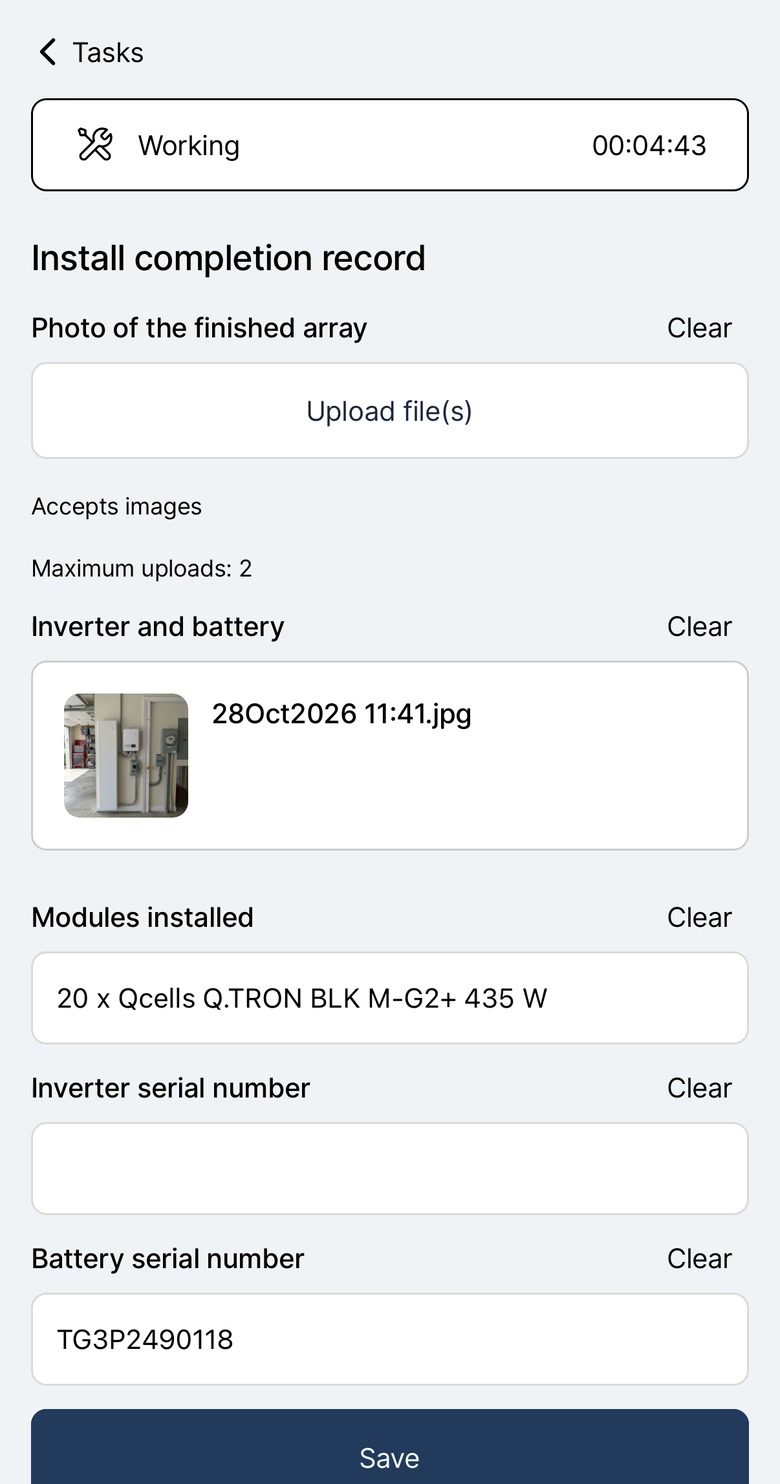
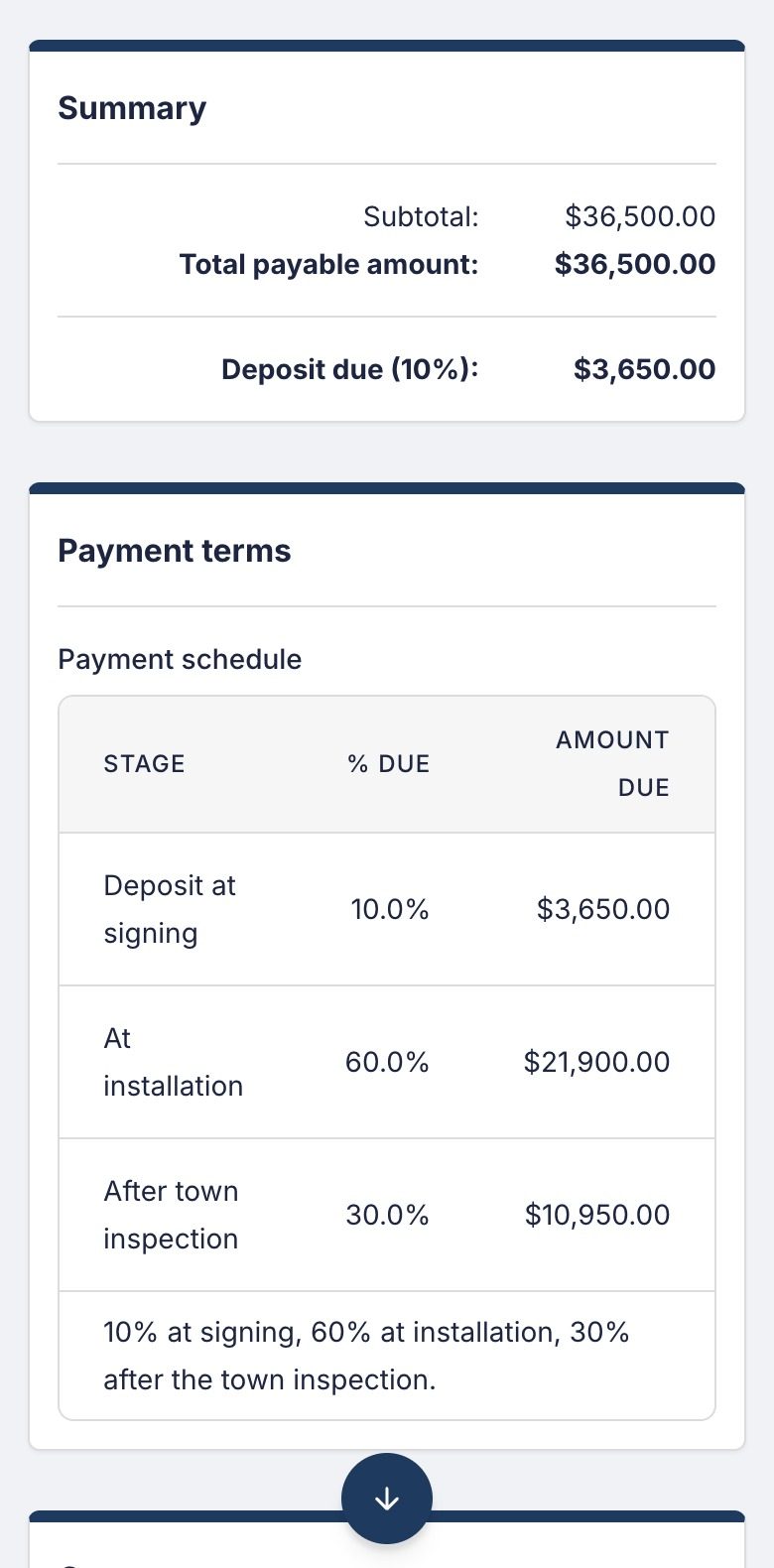
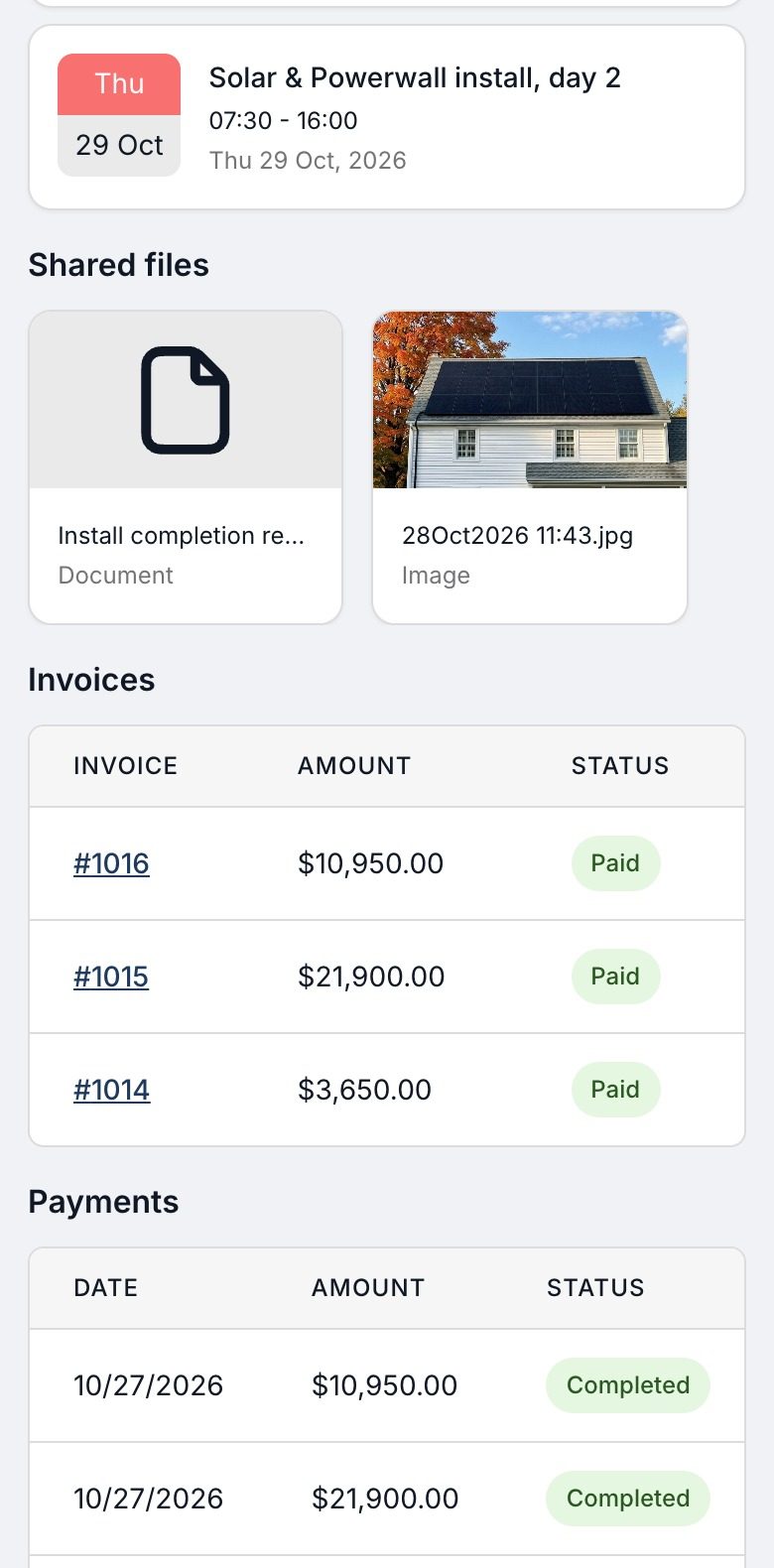
The whole job in 100 seconds
Switching from Sunbase and Enerflo
Customer and project records come across from either system through an export. We import them into Payaca through our API and import tooling: customers with their contacts and addresses, and projects at the right pipeline stage, with the custom fields, notes and files you still need.
Designs from OpenSolar import straight into Payaca proposals. If you keep a finance partner for loans, leases and PPAs, the proposal links through to their page.
Guided onboarding is available on Growth and above: we map your workflows, migrate your data and train your team, for a one-off $2,000. The pricing page has the details.
Which is right for you?
Choose Payaca if
- You want one system, not a connected stack
- You run your own crews and want the whole install on one record
- You install EV chargers or heat pumps alongside solar and storage
- You want a published price before the call
Consider Sunbase and Enerflo if
- You want PV design and production analysis in the same system as your CRM (Sunbase)
- Per-user, per-module pricing fits how you buy software (Sunbase)
- You want to keep your CRM, design and financing tools and connect them (Enerflo)
- Loan, lease, PPA and escrow financing inside the sales flow is the priority (Enerflo)
Questions
What do Sunbase and Enerflo have in common?
Both market one connected solar workflow from first contact through PTO, built from different starting points. Sunbase (Sunbase Data) builds CRM, PV design, proposals and project management into one configurable system that also serves roofing, construction and home services. Enerflo is sales software for residential and light commercial solar: its website lists its own CRM, proposals and install tracker, but its pitch is connecting the CRM, design, financing and contracting tools you already use, with 150+ integrations.
Why might a solar company choose Payaca over Sunbase?
Sunbase prices per user per month and is configured module by module, so cost and capability grow with headcount and scope. Payaca covers CRM, proposals, permits, crews, invoicing, payments and servicing in one system, with 25 users included on the Growth plan, an offline-first field app and a portal where homeowners sign and pay. If you run your own crews and want the whole install on one record without assembling it, that is the difference.
Why might a solar company choose Payaca over Enerflo?
Enerflo is built around the sale: proposals, financing and contracts, with your existing tools connected around it. That works if you are happy maintaining a stack. Payaca replaces the stack: one record from lead to PTO, with invoicing and payments, an offline-first field app for your crews, and a homeowner portal. Fewer moving parts, one vendor, and a published Growth price instead of a quote after a call.
Does Payaca handle solar financing like Enerflo?
Payaca supports multi-option proposals, including solar plus storage and solar plus EV in one document, with deposits collected on acceptance. For loan, lease and PPA deals, the proposal links through to your finance partner's own page rather than routing deals through a built-in financing marketplace.
Do they all cover batteries, EV chargers and heat pumps?
All three handle solar with battery storage. EV chargers and heat pumps aren't among the industries Sunbase or Enerflo list. Payaca is built for solar, batteries, EV chargers and heat pumps together, so a homeowner adding a charger or a heat pump stays on the same project record instead of a separate system.
Can I migrate from Sunbase or Enerflo to Payaca?
Yes. Customers and projects export from Sunbase or Enerflo and import into Payaca, and guided onboarding on Growth and above includes the migration. Request a demo to talk through what moves across for your business.
Competitor details are based on their public information as of October 29, 2026. Spotted something out of date? Tell us.